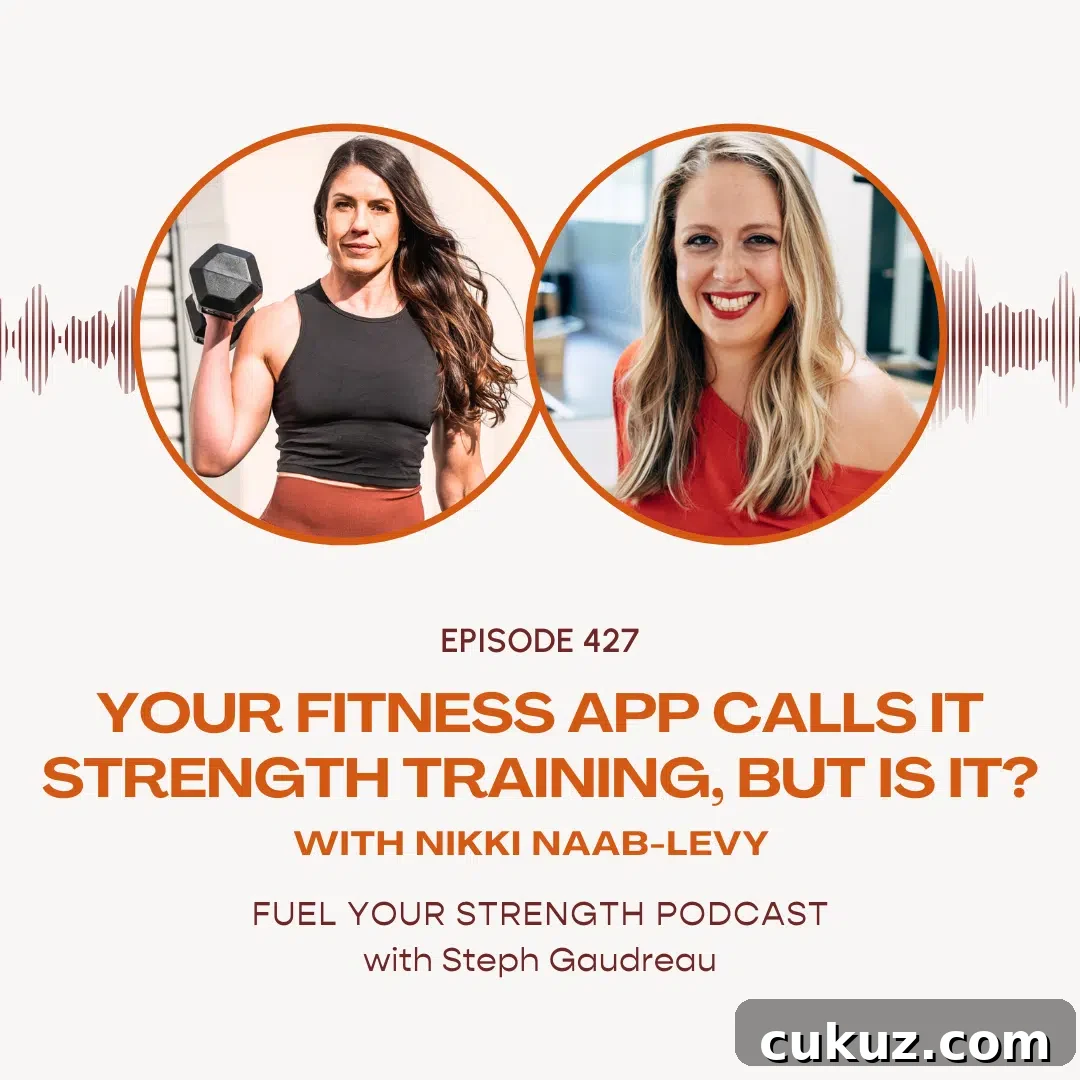
If you’re reading this, you likely already understand that strength is an essential part of caring for your body. When an app or YouTube workout is labeled “strength training,” it’s easy to assume that you’re getting effective strength work — but is that really the case? Are those sessions delivering a genuine strength stimulus, or are they simply marketed that way?
Listen to the episode directly on this page, no app required:
Or find the episode on your preferred podcast platform: iTunes (Apple Podcasts) | Spotify | YouTube
Want a free week of strength workouts? Click here to get started
Key Takeaways
If you want to take your programming seriously, start by doing these three things:
- Meet yourself where you are — no shame, no judgment.
- Learn the nuances of strength training programming so you can recognize what truly constitutes strength work.
- Work with a coach who understands your goals and can guide you safely toward them.
Going Behind the Scenes with Nikki Naab-Levy
Nikki Naab-Levy is a strength and nutrition coach with 17 years of experience. She helps women build strength, improve mobility, recover from injury, and find sustainable approaches to nutrition. She’s committed to honest conversations about fitness marketing and how it can misrepresent what real strength training entails.
Understanding the Nuance
How can you tell whether a workout on an app is actually designed for strength development, or if it’s focused on something else like muscular endurance or general conditioning? Often, you can’t tell at a glance. That’s why understanding programming details — load, rest periods, exercise selection, and progression — is essential. Marketing language can blur the difference between follow-along circuit workouts and structured strength programs designed to change muscle mass, force production, and bone density.
It’s Not You, It’s Your Workout
If a program leaves you chronically sore, tired, or stalled in progress, it doesn’t mean you’re failing — it means the programming might not fit your needs. Random workouts or high-volume circuit classes can overload some people while under-stimulating the muscles needed for true strength gains. A real strength program accounts for weak links, recovery, progression, and individual circumstances. While apps can sometimes be helpful, long-term improvements are most reliably achieved through programs built with purpose and appropriate progression.
How do you use fitness apps? Share your experiences in the comments.
In This Episode
- What separates true strength training from circuit or interval-style workouts (11:54)
- How to analyze programming offered by popular fitness apps (31:22)
- Designing a long-term plan rather than chasing short-term trends (43:45)
- The role of repetition and practice in effective training (49:54)
- Why preparation matters before jumping into advanced movements (1:04:12)
Quotes
“We are not hating on the workouts. But we want you to be able to make an informed decision so that if those are your goals, you are able to pick an approach that actually is going to work for you and help you get the results you want without feeling frustrated or feeling like your joints always hurt.” (8:00)
“We know that if you don’t feel awful all the time, and you are able to do high-quality work with appropriate weight and appropriate rest, you will be able to see the results that you want and not be super ridiculously sore.” (41:56)
“How we put things together makes a huge difference. In the short term, but particularly in the long term.” (42:50)
“Programming can be done in a very broad way, or can be made very specific to the individual, and their needs and their interests. But at the same time, there has to be some sort of logic and base.” (54:17)
“Give yourself the tools to be successful! If something is not working for you, you are not a terrible person; you probably just need a different approach or a scaled-down approach, or something needs to be adjusted.” (1:08:44)
Featured on the Show
Apply for Strength Nutrition Unlocked here.
Nikki Naab-Levy website and Instagram are referenced in the episode.
Follow Steph on social platforms noted in the original episode.
Podcast production and marketing support credited to Counterweight Creative.
Related Episodes
FYS 373: The Problem with Tiny Pink Dumbbells with Nikki Naab-Levy
FYS 358: Hypermobility and Strength Training with Nikki Naab-Levy
Transcript Excerpt: Your Fitness App Calls it Strength Training, But Is It? w/ Nikki Naab-Levy
Steph Gaudreau
You get motivated to work out, open your favorite fitness app, and choose a session labeled “strength” because you know strength matters as you age. But is that session actually delivering a strength stimulus? In this episode, Nikki and I unpack how to recognize whether an app-based workout targets real strength development or something else, and how to choose training that aligns with your goals for muscle mass, bone health, and long-term progress.
Steph Gaudreau
I’m a strength nutrition strategist and weightlifting coach. The Fuel Your Strength podcast focuses on evidence-based strategies for training, nutrition, and recovery — especially for people approaching midlife. We push back on limiting fitness narratives and explain how to train smarter as you age.
Steph Gaudreau
Welcome back. I’m excited to welcome Nikki Naab-Levy, a trusted colleague and coach who specializes in hypermobility and practical nutrition. We’ve discussed topics like Pilates vs. strength training and tiny pink dumbbells on previous episodes, and today we explore how so-called “strength” programs on popular platforms may not deliver what they promise.
Nikki Naab-Levy
We’ve talked with many people who tried “strength training” classes through apps and ended up injured, overly sore, or disappointed. Often what they call strength training is high-rep, follow-along circuit work that can look and feel like strength work at first, but lacks the load, rest, and progression needed for meaningful long-term gains. These classes aren’t inherently bad, and if you love them you should keep doing them — but they aren’t always the optimal choice for muscle growth, bone density, or maximal strength.
Steph Gaudreau
App-based programs often default to time-based intervals (for example, 45 seconds on, 15 seconds off) and use limited weight options, which prevents truly heavy lifting and adequate rest between maximal efforts. Heavy lifting requires fewer reps and longer rest to allow recovery of the energy systems and to recruit high-threshold muscle fibers. In contrast, high-rep circuits target muscular endurance and often accumulate hundreds of reps in a session, which can be excessive for people with sensitive systems or those prone to overuse injuries.
Nikki Naab-Levy
Many people, especially those with hypermobility or chronic issues, are told to avoid heavy weights and stick to light, high-rep work as “safer.” In reality, appropriate progressive loading with fewer, focused exercises and gradual increases in weight often leads to better tissue adaptation and less chronic soreness. Proper programming teaches technique, scales load sensibly, and includes deloads to prepare the body for heavier work without constant pain.
Steph Gaudreau
A common problem in app workouts is one-size-fits-all weight recommendations and minimal time to change implements. Workouts that pair heavy compound lifts with high-rep accessory moves, or that recommend the same dumbbell for very different exercises, force people to either under-load big lifts or use momentum on isolation exercises. Both approaches reduce effectiveness and increase fatigue.
Nikki Naab-Levy
We also see confusing program labels: “beginner” sessions may be more demanding than “intermediate” ones because of sequencing, rest periods, and volume. Progression requires repetition and measured load increases; endlessly changing workouts prevents meaningful progress, while repeating movements in a thoughtful plan builds strength and resilience.
Steph Gaudreau
If your goal is to gain strength, muscle, and bone health, aim for structured programming with clear progression, appropriate load, and room for recovery. You can still enjoy variety and play, but the foundation should be predictable enough to track progress.
Nikki Naab-Levy
If something isn’t working for you, it’s not a personal failure. You might just need a different approach, adjusted volume, or better sequencing. Seek coaching if you can, even briefly, to build a strong and safe foundation. Small, well-planned sessions can outperform random high-volume classes when it comes to long-term results.
Steph Gaudreau
If you’re an athletic woman over 40 aiming to improve strength, muscle, and bone density, consider a progressive, structured program rather than relying solely on generic app classes. For those ready to commit, Steph’s Strong With Steph program and Nikki’s offerings provide tailored approaches to build strength safely and sustainably.
Final Thoughts
Not all workouts labeled “strength” are created equal. Learn to read programming cues — load, rest, progression, and repetition — and choose approaches that match your current fitness, recovery capacity, and long-term objectives. With the right structure and coaching, you’ll get stronger without chronic soreness, setbacks, or wasted effort.
Ready to learn more? If this episode resonated, consider exploring dedicated coaching or templates that match your needs. A little guidance up front can save time, reduce injury risk, and accelerate progress.
Thanks for listening. Stay strong.